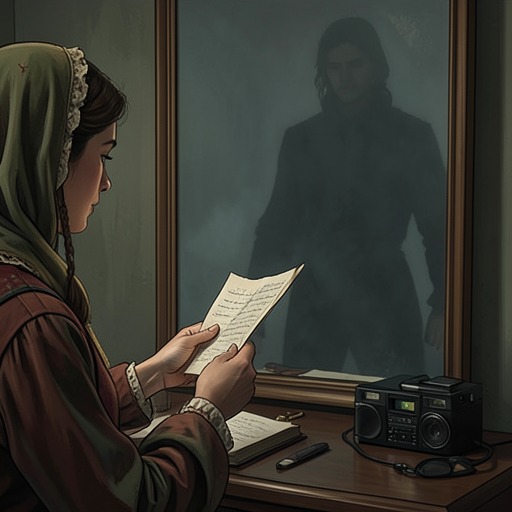
Tess's shame and concealment of her past sexual assault
Tess of the d'UrbervillesTess's shame and concealment of her past sexual assault are not simply private feelings: they govern what she tells Angel Clare, where she dares to be seen, and how she understands the judgments of her community. Her silence grows from a mismatch between her experience and the moral categories imposed upon her. Tess insists that she had been a child and did not understand the dangers she faced, but she nevertheless treats the past as a reason she cannot accept the love she wants. The resulting secrecy does not protect her from judgment; it leaves her carrying its burden alone.
Social Judgment and Withdrawal
After returning to Marlott, Tess encounters the public consequences of her history in the parish church. She chooses a back seat beneath the gallery, near the bier and churchyard tools, hoping to stay out of notice. When parishioners observe and whisper about her, she understands their attention as judgment and concludes that she can no longer go to church. Her retreat into the shared bedroom becomes more habitual, and she keeps herself so secluded that nearly everyone thinks she has left.
The distinction between her own sense of guilt and the narrator's account is sharp. At night, Tess walks alone in the woods, avoiding people rather than fearing the shadows. She imagines the weather and the winter landscape as reproach from an indistinct moral power, and sees herself among sleeping birds and rabbits as guilt intruding upon innocence. Yet the narrator identifies these moral phantoms as mistaken: Tess has broken an accepted social law, not a law of the natural world around her. Her shame is real in its effects, but the standard that produces it is presented as a human convention, not a judgment shared by the life surrounding her.
Concealment and the Refusal of Marriage
At Talbothays Dairy, Tess's hidden past becomes the obstacle she places between herself and Angel. When he proposes, she loves him and would rather belong to him than to anyone else, but answers that she cannot be his wife. The refusal is painful rather than indifferent: she bows her head in grief, and later responds to his renewed question with a grave, hopeless no when the allusion to Alec d'Urberville revives the turmoil of the past.
Tess gives Angel only partial explanations. She says she is not good enough or worthy enough and fears that his friends would scorn her. She takes her own lack of social polish as a further reason she may not belong in his world, although Angel regards her as well-informed and versatile. Beneath these stated anxieties lies her conviction that an undisclosed fact makes marriage unjust to him. She has resolved before coming to the dairy that she must not agree to a step that could later cause her husband bitter regret for having married her without knowing the truth.
The conflict is intensified by the absence of any disclosure from outside. Tess wonders why nobody tells Angel what happened, noting that it was only forty miles away, but nobody does. She is left to decide whether to speak while believing that the information should already have reached him. Her question exposes the loneliness of the secret: the past is socially consequential, yet its transmission is left to the person who feels most exposed by it.
Confession and Unequal Judgment
When Tess eventually tells Angel, she pleads that she was a child and knew nothing of men. Angel concedes that she was more sinned against than sinning, but says that forgiveness is not all that is at issue. The exchange shows both recognition and its limit. Tess's account can be acknowledged as one of victimization without removing the marital and moral consequences that Angel attaches to it. Her earlier fear that the truth would alter their marriage is thus not answered simply by his acceptance of her lack of blame.
That contrast gives the concealment its tragic force. Tess has treated disclosure as a duty and silence as a temporary defense against rejection; once the truth is spoken, it does not restore the uncomplicated future she hoped for. The event is not framed as wrongdoing intentionally chosen by Tess. Later, when injustice overwhelms her, she insists that she never intended to do wrong and understands her supposed sins as inadvertent. The distance between that understanding and the penalties she experiences reveals how readily social judgment turns a woman's past into a lasting verdict.
The Past Carried into Separation
During her life apart from Angel, Tess manages the visibility of her marriage as carefully as she once managed the visibility of her past. She does wear her wedding ring, but not publicly: she keeps it on a ribbon around her neck because she does not want people to know by marriage who she is, or even to know that she is married. Her explanation to Marian makes concealment a practical condition of getting through her present life, not a sign that the marriage has ceased to matter.
At Flintcomb-Ash, that private burden is joined to economic hardship. Tess works with Marian in a bleak, unproductive farm landscape, and patience sustains her. She gives her parents her new address in case a letter from her husband arrives, but does not tell them how sorry her situation is, because doing so might bring reproach upon Angel. The careful omission repeats the pattern established at Talbothays: Tess suppresses information not because it is unimportant, but because she fears what its disclosure may do to others and to her remaining ties.
The same pattern belongs to a broader social process. In Marlott, shrinking cottage accommodation and the preference for houses occupied by farm workers make the Durbeyfield family vulnerable to removal. On the first Lady-Day when they can be expelled, their home is required for a carter's large family. The household's perceived moral standing is invoked alongside that material pressure: the village is to be kept pure, and the family is tacitly regarded as one that must go. Tess's concealment cannot insulate her from a community in which stigma has practical consequences for belonging and security.
Significance
The novel distinguishes Tess's conduct from the labels attached to it. Her mother's complaint that Tess failed to secure marriage with Alec treats marriage as a possible benefit to the family; Tess's own account is that she had been a child, unwarned about danger, and had not chosen the outcome now used against her. The contrast reveals how little room she is given to define her experience on her own terms: others assess it by its usefulness, respectability, or effect on marriage, while Tess struggles to name it as something done to her.
Concealment therefore recurs as both a response to stigma and a source of further isolation. The whispers that end Tess's churchgoing, the explanations she cannot bring herself to give Angel, the ring hidden beneath her clothes, and the news withheld from her parents are distinct acts of self-protection, each shaped by anticipated judgment. But none can make the past disappear. Its most consequential effect is not that Tess accepts the verdict against her as just; it is that she is compelled to organize love, work, family loyalty, and public visibility around the fear that other people will treat her history as a permanent measure of her worth.